


Electric Vehicle engineers face a recurring nightmare: designing an ultra-fast charging battery pack without turning the vehicle into a toaster.
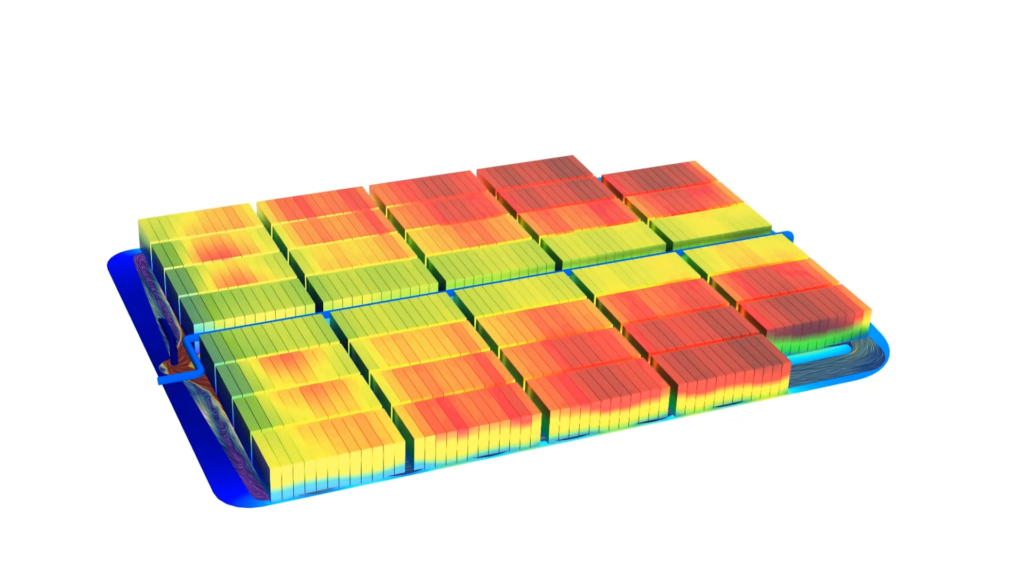
We've all heard the promise "Charge from 10% to 80% in under 10 minutes!" But every Thermal engineer knows the hidden catch. Super-fast charging - dumping hundreds of kilowatts into a battery pack leads to intense, uneven heat. A temperature variation of just a few degrees across a module can slash its overall battery life by double-digit percentages. The culprit? Thermal hotspots, unpredictable fluid dynamics and cold-flow imbalances.
To stop these battery thermal disasters, Computational Fluid Dynamics CFD has always been the ultimate weapon. But classical CFD comes with a painful trade-off: TIME. Building complex 3D Meshes and running high-fidelity Navier-Stokes solvers on every design iteration takes days to weeks.
What if you could bypass the solver entirely? What if you could evaluate hundreds of battery cooling designs in seconds with accurate 3D Physics?
Enter the ultimate engineering power couple: Simcenter Physics AI and Simcenter STAR-CCM+
The challenge in Next-Gen Battery Cooling
Whether you are designing complex micro-channel cold plates, experimenting with dielectric immersion cooling or optimizing phase-change material gap pads, the physics of battery cooling is most often multi-domain. Engineers must account for transient heat conduction, turbulent coolant flows, Conjugate Heat Transfer CHT and electrochemical heat generation - all simultaneously.
In the traditional setup using Simcenter STAR-CCM+, you set up your parameterized geometry, generate a refined polyhedral mesh, run the multi-physics solver and wait. STAR-CCM+ yields exceptionally accurate thermal maps and pressure-drop predictions. But if you want to test 50 different coolant channel shapes, tweak tab locations or re-route fluid manifolds, your design cycle quickly turns into a multi-week waiting game.
This is where product launch deadlines die. But it's also where Physics AI steps in!
Physics AI: Machine Learning Built for 3D CAD Shapes
Most traditional AI models in engineering are rigid. They rely on simple numbers in a spreadsheet like length, width or flow rate and spit out a single result. But if you change the actual 3D shape of your cold plate or add new cooling fins, the old AI breaks. It simply doesn't understand physical geometry.
Siemens Physics AI changes everything by reading 3D CAD models and meshes directly.
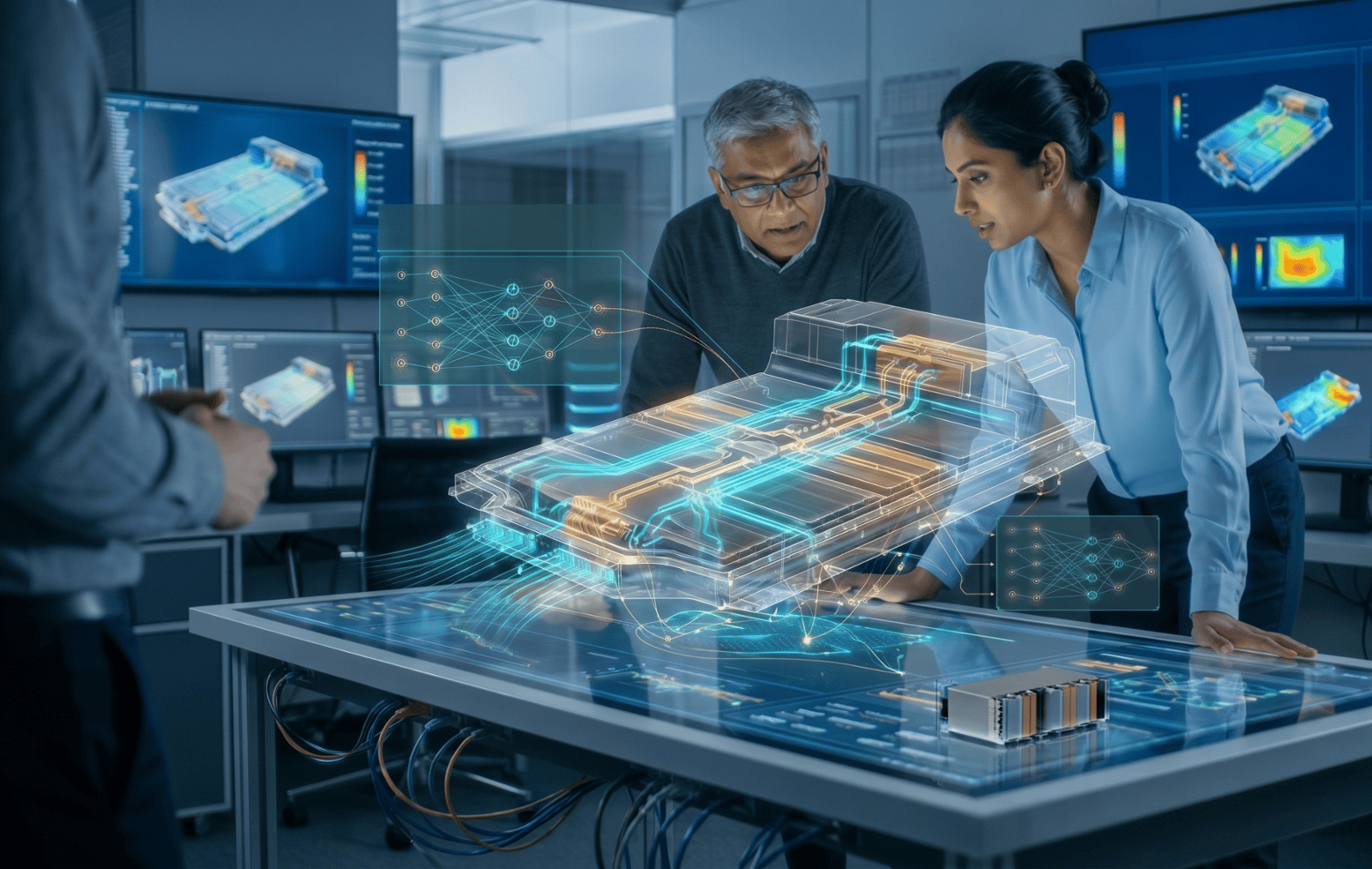
Instead of relying on rigid parameters, Physics AI evaluates the actual spatial shapes of your battery components using geometric deep learning. It looks at your complex 3D models, understands how fluid flows through curves and manifolds, and predicts thermal performance instantly.
Here is how the workflow transforms battery thermal management:
- Train on True Physics: You run a batch of high-fidelity thermal simulations in Simcenter STAR-CCM+ across varying geometries and coolant flow rates.
- Feed the AI: Physics AI ingests this full 3D CAD/mesh data, learning how shape changes impact flow distribution, thermal hotspots and pressure drops.
- Instant Predictions: Once trained, an engineer can evaluate a completely new battery pack or cold plate design. Physics AI predicts full 3D temperature fields and flow velocities in milliseconds, right on the mesh.
- Eliminate Dead Zones: Instantly visualize if a new channel layout causes stagnant, overheating fluid pockets in a cold plate.
- Interactive Design Exploration: Slide CAD features in real-time while watching surface temperatures update live on screen, turning passive simulation waiting into active design.
- Filter Out Bad Designs Instantly: Screen thousands of pack concepts in minutes, reserving computationally expensive STAR-CCM+ runs only for final design verification.
From Concept to Cold Plate in Seconds
- You get the unmatched physical rigor of STAR-CCM+ to capture thermal runaway risks, electrochemistry and complex 3D fluid dynamics.
- You get the near-zero latency of Physics AI to predict 3D fields instantaneously, granting complete design freedom.